
Wuxi Overpass Accident Caused by Overloading
Date:2026-10-28
Page views:
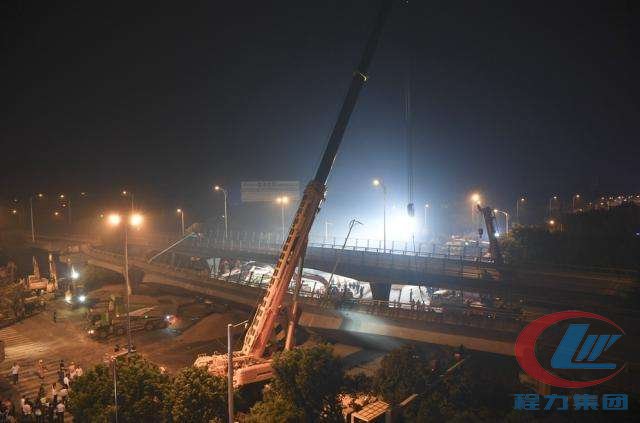
At about 18:10 on October 10 yesterday, a deck overturning accident occurred at the K135 section of National Highway 312 in Wuxi City, Jiangsu Province, at the Xigang Road overpass. The Wuxi overpass accident was caused by overloading. At the scene, besides a vehicle carrying large steel coils on the overpass, several moving vehicles were also crushed. The reporter learned from the accident rescue headquarters that after on-site search and rescue, it was confirmed that a total of 3 cars were crushed under the bridge, one of which was a parked vehicle (with no one in it, and the driver had been found), and the other 2 cars carried a total of 3 people, all of whom had died. There were 5 vehicles on the overturned bridge deck, including 3 cars and 2 trucks. The accident caused 3 deaths and 2 injuries.
According to the investigation team of the Wuxi overpass collapse accident, 4 trucks tipped over the right side of the ramp in the same direction and fell to the ground, numbered from 1 to 4 in order from north to south. Truck 1 (plate No. Hei AH3976) is a 2-axle truck; trucks 2 (Liao M45107), 3 (Hei E52268) and 4 (Hei L82392) are all 6-axle heavy semi-trailers, all of which are non-standard vehicles. After investigation and actual weighing, truck 1 has a rated load of 9.6 tons and an actual load of 12.42 tons, with an overloading rate of 29.375% and a total vehicle and cargo weight of 18.625 tons; truck 2 has a rated load of 30 tons and an actual load of 125.23 tons, with an overloading rate of 317.43% and a total vehicle and cargo weight of 153.29 tons; truck 3 has a rated load of 31.235 tons and an actual load of 134.55 tons, with an overloading rate of 330.77% and a total vehicle and cargo weight of 163.59 tons; truck 4 has a rated load of 31.3 tons and an actual load of 123.2 tons, with an overloading rate of 293.61% and a total vehicle and cargo weight of 149.68 tons. The total rated load of trucks 1 to 4 is 102.135 tons, the total actual load is 395.4 tons, the total overloading is 293.265 tons, and the total vehicle and cargo weight is 485.185 tons.
 In recent times, the national relevant departments have continuously stepped up the investigation and punishment of “large-tonnage-but-small-labeled” light trucks, and require that light trucks illegally produced be unconditionally taken back and replaced by the production enterprises. At the same time, in the 22nd batch of road motor vehicle production enterprises and product announcements issued by the Ministry of Industry and Information Technology, thousands of flatbed dump trucks/semi-trailers of 374 enterprises do not meet the provisions of Amendment No. 1 of the “Technical Conditions for Safety of Motor Vehicles” (GB7258-2017), and it is required that production be stopped from August 1 this year and sales be stopped from February 1, 2020. This shows that flatbed dump semi-trailers will also withdraw from the historical stage.
In fact, besides “large-tonnage-but-small-labeled” light trucks and flatbed dump semi-trailers, there are still many non-compliant models in the highway freight market, which truck drivers often complain about, including front-4-rear-8 dump trucks, and 13.75-meter and 17.5-meter low flatbed transport trucks. These non-compliant models often have serious over-limit and overload problems, and the transported goods seriously do not match the goods permitted to be transported, seriously disrupting the order of the highway freight market.
Non-compliant models breed market chaos, and many traffic accidents are caused by non-compliant vehicles
Why are there so many non-compliant models in the road transport industry? In the view of industry insiders, the main reasons are ineffective supervision by law enforcement departments, wanton behavior by producers, and a fluke mentality by users. “In some regions, the regulatory departments collude with users and producers, further breeding chaos in the highway freight market.” The above-mentioned industry insider pointed out.
A person in charge of a heavy truck enterprise told reporters in an interview that the curb weight of front-4-rear-8 engineering trucks in the transport market of the Sichuan-Chongqing region can generally reach more than 20 tons. If strictly implemented according to the “Regulations on the Administration of Over-limit Transport Vehicles Traveling on Highways”, this model can only load about 10 tons of goods. Compared with before the implementation of the “9·21 overload control new policy”, the load capacity is reduced by about 10 tons. “However, at present, the recognition standard for over-limit and overload of front-4-rear-8 engineering trucks in some regions of China is still 40 tons. In some regions with lax management, four-axle engineering trucks carrying seventy or eighty tons are not uncommon, posing great safety hazards.” He said.
In addition, 13.75-meter and 17.5-meter low flatbed trucks are also often criticized by industry insiders. These two types of models can only transport large goods that cannot be dismantled according to regulations, but because their lengths reach 13.75 meters and 17.5 meters respectively and their widths reach 3 meters, with obvious cargo advantages, many truck drivers use these two types of models for general cargo transportation.
The collapse accident of the Jiangsu Wuxi overpass indicates that it is imperative to regulate non-compliant vehicles
It is understood that there are still a large number of flatbed semi-trailer dump trucks and low flatbed trucks on the market, and many truck drivers have expressed dissatisfaction with this.
“The profits obtained by users of non-compliant models are themselves built on the losses of others, so increasing the intensity of regulation is necessary and is also the general trend.” Shandong truck driver Zhao Qiang told reporters that because non-compliant models have obvious advantages (large cargo capacity and strong freight rate adjustment ability), the purchase cost of the vehicle can be recovered very quickly, but their operating model is difficult to sustain in the long term and does not help improve their own competitiveness. In essence, it harms themselves and also harms others. Therefore, from the perspective of the healthy development of the whole industry, regulating non-compliant vehicles is imperative.
According to the investigation team of the Wuxi overpass collapse accident, 4 trucks tipped over the right side of the ramp in the same direction and fell to the ground, numbered from 1 to 4 in order from north to south. Truck 1 (plate No. Hei AH3976) is a 2-axle truck; trucks 2 (Liao M45107), 3 (Hei E52268) and 4 (Hei L82392) are all 6-axle heavy semi-trailers, all of which are non-standard vehicles. After investigation and actual weighing, truck 1 has a rated load of 9.6 tons and an actual load of 12.42 tons, with an overloading rate of 29.375% and a total vehicle and cargo weight of 18.625 tons; truck 2 has a rated load of 30 tons and an actual load of 125.23 tons, with an overloading rate of 317.43% and a total vehicle and cargo weight of 153.29 tons; truck 3 has a rated load of 31.235 tons and an actual load of 134.55 tons, with an overloading rate of 330.77% and a total vehicle and cargo weight of 163.59 tons; truck 4 has a rated load of 31.3 tons and an actual load of 123.2 tons, with an overloading rate of 293.61% and a total vehicle and cargo weight of 149.68 tons. The total rated load of trucks 1 to 4 is 102.135 tons, the total actual load is 395.4 tons, the total overloading is 293.265 tons, and the total vehicle and cargo weight is 485.185 tons.
In fact, besides “large-tonnage-but-small-labeled” light trucks and flatbed dump semi-trailers, there are still many non-compliant models in the highway freight market, which truck drivers often complain about, including front-4-rear-8 dump trucks, and 13.75-meter and 17.5-meter low flatbed transport trucks. These non-compliant models often have serious over-limit and overload problems, and the transported goods seriously do not match the goods permitted to be transported, seriously disrupting the order of the highway freight market.
Non-compliant models breed market chaos, and many traffic accidents are caused by non-compliant vehicles
Why are there so many non-compliant models in the road transport industry? In the view of industry insiders, the main reasons are ineffective supervision by law enforcement departments, wanton behavior by producers, and a fluke mentality by users. “In some regions, the regulatory departments collude with users and producers, further breeding chaos in the highway freight market.” The above-mentioned industry insider pointed out.
A person in charge of a heavy truck enterprise told reporters in an interview that the curb weight of front-4-rear-8 engineering trucks in the transport market of the Sichuan-Chongqing region can generally reach more than 20 tons. If strictly implemented according to the “Regulations on the Administration of Over-limit Transport Vehicles Traveling on Highways”, this model can only load about 10 tons of goods. Compared with before the implementation of the “9·21 overload control new policy”, the load capacity is reduced by about 10 tons. “However, at present, the recognition standard for over-limit and overload of front-4-rear-8 engineering trucks in some regions of China is still 40 tons. In some regions with lax management, four-axle engineering trucks carrying seventy or eighty tons are not uncommon, posing great safety hazards.” He said.
In addition, 13.75-meter and 17.5-meter low flatbed trucks are also often criticized by industry insiders. These two types of models can only transport large goods that cannot be dismantled according to regulations, but because their lengths reach 13.75 meters and 17.5 meters respectively and their widths reach 3 meters, with obvious cargo advantages, many truck drivers use these two types of models for general cargo transportation.
The collapse accident of the Jiangsu Wuxi overpass indicates that it is imperative to regulate non-compliant vehicles
It is understood that there are still a large number of flatbed semi-trailer dump trucks and low flatbed trucks on the market, and many truck drivers have expressed dissatisfaction with this.
“The profits obtained by users of non-compliant models are themselves built on the losses of others, so increasing the intensity of regulation is necessary and is also the general trend.” Shandong truck driver Zhao Qiang told reporters that because non-compliant models have obvious advantages (large cargo capacity and strong freight rate adjustment ability), the purchase cost of the vehicle can be recovered very quickly, but their operating model is difficult to sustain in the long term and does not help improve their own competitiveness. In essence, it harms themselves and also harms others. Therefore, from the perspective of the healthy development of the whole industry, regulating non-compliant vehicles is imperative.